Showing posts with label Pete's Mission. Show all posts

Saturday, 28 May 2011

Fraud, Babies, Excuses and Crowd-Sourcing

SANY0010It’s all been a bit quiet on the gaming front recently. I was going to have a terrific article going into more detail about planning terrain, but it’s a little too dull and rambling at the moment. I’ll probably have to edit, re-write, and maybe completely ignore it before the end. Instead, I was planning to get on with actually building the terrain. Unfortunately, my bank account was targeted for fraud (didn’t lose anything, but my card was blocked) so my bits and materials order has been put on hold while I wait for a new card to come through. While this does prevent gaming-related expenditure, I’m aware that a certain minimum amount of expense is necessary in certain circumstances. Hence – no building, no blog post. Also, as this post isn’t going to be too interesting (it is mainly a list of excuses, but there is a point near the end) I won’t count it as my monthly quota of blogging and I’ll try to make it up in June when things get back on track.

On the actual playing side, I’ve been unable to get in a proper long game for a while as a work deadline looms up (seventeen and a half hours overtime last weekend, whee), and home life gets slightly more hectic as we are expecting a baby any minute now (due date is less than two weeks now). And being nine months pregnant isn’t easy on a person, so I’ve picked up extra household tasks, and reduced my gaming time.

The aforementioned conferences are interrupting my weekly RPG session (we’re English and Scottish heretic hunters in a slightly homebrew RuneQuest game set in the 15th Century with demons and magic, chasing down French leper monks for the ampulet of anointing oil used to crown the French kings, if anyone is interested) – probably the first one I’ve missed – and last week’s was off as the GM and half of the players were in Italy at a medieval re-enactment event. I did manage to salvage that one with a game of Talisman with other non-combatants, which was surprisingly easy to remember the rules for and a lot shorter than some previous games – I thank Lady Luck for that one, as my wife’s Dwarf picked up a Talisman early in the first couple of turns, and my Wizard managed to engage in psychic combat and steal it (then grab an axe and sail off to the end, out of reach of retaliation).

Now that all of that’s off my chest, I’ll get to the point of the post. In trying to get parts for my Necromunda scenery, I’ve gone to all of my normal ‘small plastic parts’ web stores, and even visited Antics in Bristol to get a better look at things. It occurred to me after reading Shadowbadger’s blog (recommended to me by @Bjoyhoy on Twitter) that everyone has a different set of go-to shops to get their hobby materials from. Where does everyone get their materials from? I’m not thinking of models themselves, but the plasticard, thin rod, tubes and chain that can be used for conversions and the like. Also, I’m not after the cheapest, just a range so that prices can be compared – an expensive shop may have a great deal on one thing or an exclusive item that’s perfect for a particular project.

What I hope to do is to create a list of these shops in a separate post that we can keep updated as we find new shops and sources, to save raw Googling (with Bing), to be a reference to hobbyists like ourselves. Suggestions in the comments below, and thank you very much!

Tuesday, 26 April 2011

Frugal Terrain for a Frugal Game – Necromunda Experiments

Excuse me for a minute while I ramble on a bit, to introduce a new project...

My second frugal year is going extremely well so far, as I’ve managed to squeeze in a few games of Necromunda recently. Part of that is helped by (finally) being able to drive across the country to visit family, and be able to catch up with old gaming friends. Technically, the petrol is expensive (oh boy, is it expensive) but it’s a cost I’d be shouldering anyway. As a bonus, I could play against my wife while our first gamer-in-training was being watched by his aunt. For my goals so far this year – I am a couple of hours behind on my painting, but that should be sorted later this week thanks to the Royal Wedding. The gaming budget has been used up till June, because I am a complete sucker for a Dawn of War game, and used up five months on it near the beginning of the year.

All this Necromunda has re-inspired me to work on some scenery for the game. It might just be what I’m used to (my original opponent had two box sets, two Outlanders sets, and the Imperial Bastion, Bunker and Firebase card scenery), but it just doesn’t feel right playing on a flat table with a single level of scenery. I much prefer thinking in three dimensions, trying to get up and down very specific points (the house rules are quite unforgiving about ladders and their usage) to get good covering positions. With only a Gorkamorka fort and ‘blocking’ terrain (hills, rocks, crashed spaceships), it’s not quite the same at all.

This is one thing that makes Necromunda – a free-rules game with a limited model requirement – less than frugal, for my preference. Don’t take this as a frugal game review, however – the game is far and away (if you consider Gorkamorka to be ‘merely’ an awesome variant, as I do) the best and most frugal wargame I’ve found. The problem is that the game improves amazingly with more scenery, to the point that reducing that scenery rankles slightly.

We’ve made do in a pinch with Lego terrain – multiple levels, ramps, and infinitely configurable, but the nightmare industrial Underhive will always look exactly like Toy Town. This never really bothers me any more than unpainted models or scenery bother me, but it’s still something I would rather correct.

Alongside the Lego, I’ve tried some of the Hexagon and Platformer sets – as many people have discovered, this is almost perfect for Necromunda. It’s even in a nice dark grey plastic that doesn’t necessarily need to be painted, so it can be disassembled for storage or reconfiguration. This, however, is hardly frugal at all. If I recall correctly (it’s been a while since I got them), the sets cost around £13 each and each make a single medium-to-large structure (as tall as the original card buildings but not as big a base area) with spare parts. To reproduce the original box sets cardboard scenery would cost at least £50 – incidentally, looking at the prices of the original terrain on eBay aren’t far off.

Next, I took the advice of every beginners terrain article through the years and got some expanded polystyrene – rather, I convinced the wife not to throw away the cupboard full of polystyrene that was delivered with our white goods. I cannot say for other modelling projects (they probably make good bases for hills, block buildings or other solid terrain) but this was a bad idea. We had perfect shapes in the polystyrene to create a ruined building with exposed elevator shaft, around six storeys tall. However, to make the polystyrene stable it couldn’t be cut thinner (it was almost two inches thick), so each floor of the building was nearly five inches high – an original Necromunda bulkhead was three inches high, and the cardboard floor is of negligible thickness. I compared the half-finished scenery to the original stuff, and placed it on the table to think about how we’d play it. It didn’t look good, since it obstructed so much line of sight both from within and without – effectively cutting the table in two. Even shortening the piece wouldn’t work, since it had all solid walls. That’s something very different to the cardboard scenery, which is quite open.

I’ve tried things that looked wrong, felt wrong, or cost too much. The kits were quick and beautiful, but small for their cost. The Lego was similarly quick and cheap (I’ve got buckets of Lego older than I am) – but would never look right. The expanded polystyrene was cheap (it’s rubbish), but would take a lot of time to produce something that didn’t work well enough.

Making all these comparisons to the original scenery has given me my next experiment. I’m no great designer, but I am great at criticising. Criticism, turned around, is constructive as a list of requirements. To make new scenery in the spirit of the old, it needs to have:

  • Large-ish flat surfaces for plenty of movement
  • Open walls
  • Minimum of vertical usage
  • Ability to attach walkways and connecting pieces
  • Cheap

As I said, I’m not a great designer, so I have a scan of the original cardboard stuff and I’m going to copy it. I even believe I can improve on it for a small outlay of time and money – by building it out of plasticard, it will be more durable than the original scenery (good for someone like myself who throws all the scenery into a box and stuffs it in a corner). It will also let me model with it slightly better – I wisely lost a bottle roll early into a long multiplayer game on Saturday, and spent the rest of it examining the terrain for tips and ideas. There are some great touches added to the graphics, like exposed panels, thin pipes/hoses and vents, that could be modelled without making it too difficult to stand on.

The difficulty comes in that, as Von has discussed before we must watch the temporal investment of the hobby. I’ve saved a lot of time over the years by not painting models, but now I’m trying to correct that. It’s also a time when my time is more in demand – as a student, I thought/pretended I was busy, but as a full-time employee and father, I would slap that younger self for being such an utter nit. There is, however, a solution for this. As I come back to being in credit (see above, regarding Dawn of War) with my gaming budget, I can afford some of the more exotic plasticard I need (L-shaped angle lengths, thinner for decoration, etc) to make it look like a quality reconstruction and not just a thick cardboard knock-off. I technically come back into budget in the middle of June, but I might take an advance on that as I’ll be near a hobby shop before then getting supplies for ‘macro-modelling’ (aka DIY), and just accept that winter will be devoid of any new modelling goodies.

Writing this, I’ve also noticed that it’s something I can write about similar to the completely unrelated (except it also has the word Necromunda in it) ‘teach myself unit testing’ experiment at my own shameless plug blog (warning: I am a programmer in another life, this is not about gaming).

Next month, I’ll try and describe how I think I’ll solve the problems that reproducing the terrain in plasticard sheets will cause...

Tuesday, 22 March 2011

Game Review – Order of the Stick

I’ve noticed this blog has become really active in the last month, with some great wargaming and frugalling articles, so I thought I’d contribute something slightly different. To keep up with my frugal resolutions – I’m a couple of weeks behind my painting obligations, but catching up fast and well within my budgetary limits (I’ve spent nothing) despite several temptations (having played more Gorkamorka/Necromunda and read more of tUGS). Not just spending less, but definitely playing a lot so far this year (see here and here)! Without further ado, a schizophrenic game review.

imageThe Order of the Stick is a humourous webcomic, which lampoons tabletop RPGs – the basic question being ‘how would the characters (without players) live, act and converse if they understood the rules of the game?’. There is also an adventure game, which gives the flavour of a tabletop RPG without actually being one. Being a fan of one, I picked up the other.

The game is fun, and funny, although in my experience some of the jokes go over people’s heads if they’re not familiar with the comic. Although it stretches to about five book collections (possibly more) the game was produced early on, and really only re-enacts events from the first book – and the additional expenditure of a book isn’t required, since all the comics are online, free to view. How’s that for frugal?

Gameplay revolves around getting your pseudo-RPG character down the levels of a randomly generated dungeon (draw cards for rooms) until you reach the bottom level – where you need to defeat the boss (a lich named Xykon) and then escape. Along the way, you level up by gaining ‘shticks’ – additional cards that represent your powers increasing. You also gain loot from defeating enemies, which is important at the end – whoever escapes with the most loot, wins. An additional twist, however, is that loot needs to be relevant to your character. One character loves food, another loves treasure, a third knowledge... occasionally, these will cross over and loot will be desired by more than one player.

The game is very good at providing new experiences – rooms are selected at random by drawing cards, many of them have special rules, some of the loot is actually a trap, and everything has the flavour of the comic strips humour. Unfortunately, if you play too many times in a short space of time, the jokes can feel a bit overplayed. They would probably work well in a games night setting, where people, beer and popcorn often bring up those sorts of jokes anyway. Typical game-table humour.

Unfortunately, I’ve never tried it out at a games night because the rules are not quick to learn, especially to an audience not familiar with the common concepts of an RPG. The same people would probably not enjoy the jokes so much either, which need an understanding of popular RPGs even more. To them, it would probably appear overly-complicated and irreverent. Some people might like that sort of thing, but it’s difficult to predict that. Even if all those things come together alright, for me as a fan of the series already, there seem to be a lot of the jokes based on knowledge of the Order of the Stick comic and not just in the style and source of it’s humour. People might get the rules quickly, understand the dragon-colour jokes, but still fail at the fun poked at a character’s personality quirks. This can be off-putting to some players.

games/APE/oots3.jpgAnother problem with this as a party game is that it takes a long time to play – a bit like Talisman, you’ll probably want to take an evening playing one game of Order of the Stick and nothing else. Games nights are best when there is a variety of games to play, when everyone can pick up the rules to a sufficient level fairly quickly (ie, Kill Doctor Lucky!) and when everyone feels included. An alternative is when a significant proportion of players already know the game being played so everyone can help new people learn, and everyone knows what game they’re going into beforehand. It’s less of a ‘games night’ and more of a ‘Talisman night’ or ‘Order of the Stick night’ (although it’s still hard to stop games nights becoming ‘Kill Doctor Lucky nights’).

So, despite being a very fun game, the time investment to play it is a little too high to make it an frequent occurrence. I’ve not tried to play it since our son got walking around, because (with the random dungeon layout / size) it’s difficult to find somewhere to play that he won’t end up walking on things, and he’s likely to finish any nap before the game is done. At around £35 (although I can’t find it in 30 seconds on Amazon to confirm), it’s just a little too high for a game that can’t be picked up and played anytime, especially if you already own games that fit into the same sort of ‘long-play, complex rules’ bracket. It probably won’t get a lot of action.

That being said, while researching for this review, I found reference to a new expansion for the game (board game expansions are still something a little strange to me...) called ‘The Shortening’ that promises to make the game quicker and simpler – which is a good move, given what I’ve mentioned here. But then, that’s increasing the cost ever so slightly again...

Finally, this is a Frugal game review – is the game good value for money, will you get a lot of use and play out of it, what does it require that you bring along with you. If you have enough cash for an expensive board game, oodles of time, and loads of gamer mates who have nothing to do of a weekend, you’ll love this game – it’s very funny, and great fun. I’m not so lucky, and our regular roleplay group is having enough trouble trying to find time to roleplay without bringing them another game to play!

(images stolen from www.ookoodook.com)

Monday, 7 February 2011

2011 Already? Time to Check In

Hey everyone, Pete here. I’ve been pretty busy, working hard on my frugal plans for the new year.

As some of you may remember, I made some resolutions for the first time last year and it worked fairly well, so I’ve decided to make some this year too. I found that they work best when there are targets, limits and tangible goals.

It’s taken me a little while to work out exactly what my goals should be for this year. I want to write at least once a month for this blog (whoops…), and I definitely want to spend less on gaming stuff. I was on a bit of an eBay splurge last year, and over Christmas I was sorely tempted by many shiny new things. Luckily, I kept away from them, but I can think of a few poor spending decisions I made over the year.

To achieve the frugal goal then, I have four measurable objectives this year.

Firstly, I will spend no more than £5 a month on games or gaming things. This is especially severe since I realised just how many models are boxed up in my study, and how many Dark Elves I failed to paint last year. Buying new things before old things are painted is a major sin, and this will help me limit my guilt. The other big reason for this is the expected arrival of my second child in June (hooray!) and attendant budget reduction. Small children reduce the time available to play now, but when they grow older the plan is to mould them into mini-gamers (mini-miniature-gamers, or mini-mini-gamers?). I always loved slow-burn strategy, playing the long game.

Secondly, I will be aiming to have a day of wargaming at least once a month. I had a nice day of Gorkamorka last month (a fantastic game, and still keeping the interest after all this time), and I’m going to try and schedule a game of Warhammer with a friend who got me into the whole hobby later this month. That’ll be a nice nostalgia moment.

Thirdly, I’ll be aiming to write on this blog at least once a month. I got a bit side-tracked by other things last year, but with better time-management I’m sure that I can keep it organised. A side effect of this will probably be more games nights (to make use of games already paid for) to help me find something to write about!

So that’s my ‘quick, you lost January already!’ catch-up post. We’ll see how well this plan works out. Expect to see insightful, detailed, analytical posts about gaming if I can organise my time better, or about carpet shopping for the nursery if my wife organises it instead. Fingers crossed, frugal gamers!

Sunday, 5 December 2010

Back on the Wagon

My gaming has been suffering recently. I’ve definitely been on target with ‘spend less’ – although the temptation to grab a new rulebook or two has been pretty strong, I’ve managed to avoid it. Unfortunately, real life has been getting in the way of getting any actual gaming done – I’m busy, my gaming group is busy, no-one ever lines up a day together. I have, however, used a few days off of work to get ahead on my Dark Elf painting.

The particular style of batch-painting that I favour is ‘do every model at once’, meaning that my current batch is about 60 Corsairs. The downside to this is that until you pick up a model and examine it, as I did this week, it becomes difficult to work out how far away you are from completing. I’m just about entering the final detail stage, which for me means that I’ll be dividing models up into groups of ‘haves’ and ‘have-nots’ for particular things. The first will probably be gemstones – every model with a gemstone goes in one group, which becomes a small batch for painting. When that’s finished, I’ll go through the batch checking out models to see if they need anything else done – belts, buckles, whatever. If they don’t, then I can actually call that model finished! So for me, entering this ending stage is very exciting, because the psychological obstacle of having sixty scowling warriors staring at you on a painting table makes the sense of achievement that much greater. And the increased sense of achievement will make me want to play more, meaning it’ll be more likely that I manage to organise a game!

Another thing I was doing with my free time was planning a role-play campaign. I’ve got a rough skeleton story sketched out, I just need to flesh and structure it a bit more and see what it becomes. My gaming group also have a role-play campaign going that was geographically inaccessible to me, but has fortunately moved closer, that I’m now invited to. That’s a weekly affair that will score many many points on the ‘play more’ part of the deal, and possibly save me the trouble of buying new rulebooks – role-play groups are great for borrowing and sharing books, or buying second-hand. That should also help nip the temptation to spend in the bud.

I think role-playing games are one of the best kinds of games for a frugal and/or social gamer – you might well buy a few expensive rulebooks, but you can bet that someone else in the group has done the same and that becomes a pooled resource. To get started, all you need is to borrow some dice (or still rather frugally, buy your own set for a few pounds) and there you go! I’d heard somewhere that they first took off in popularity around the time of a recession, where people were watching their spending and to have a game based almost solely in imagination was a very frugal way of enjoying yourself – it may not be true, but it sounds plausible!

So to recap, I’ve had a lousy time of not playing enough games. Real life has been interfering, preventing the planning of games nights (for my board games fix) and regular wargaming opponents. But it looks like regular gaming is getting back on the agenda, and if there’s one thing that I’ve learned from my new year’s resolution experiment, it’s that having a real plan of action (not just a hopeful goal) will make all the difference. So you can expect next year’s plans to be much more solid!

Wednesday, 12 May 2010

Game Review – Kill Doctor Lucky!

Kill Doctor Lucky is a board game, the spiritual prequel to Cluedo. Instead of stalking around a mansion trying to work out who did it, you’re stalking around the mansion trying to do it.

150px-TitanicKillDoctorLucky The way to win the game is relatively simple – get yourself in the same room as Dr Lucky, make sure no-one can see you, and try to do him in with whatever weapons you may have picked up (or your bare hands). Other players then take it in turns to play failure cards to try and thwart your attempt. If you succeed, you win! If you fail, you get a spite token – which, for as long as you hold it, increases your chances of success.

The rules themselves are easy to pick up, and the game has become a staple in our games nights for being quick to learn, quick to play, ruthlessly mercenary and with a splash of gambling too. “Should I play this failure card to stop Ann, or should I refuse and make Carl use his cards... ensuring that my own murder attempt will be more likely to succeed!” This does, of course, backfire occasionally – we’ve had more than one game end early due to over-ambitious would-be-killers.

The game has nice, black humour and each failure card includes a reason for the failure - “The doctor spins around and waxes lyrical on his recent polar adventure.” The weapons in the game are also good – a monkey hand (bonus in the lobby), ‘loud noise’ (bonus in the carriage house, picture of a French horn) and killing joke are all in there, as well as simpler ones (revolver, knife, etc). Besides, competing to murder someone is a fairly funny thing to do when you’ve got a bunch of friends, a glass of wine and some takeaway pizza.

We picked up the reprint of the game in full technicolour glory, nice wooden playing pieces and big box. Originally, it was released by Cheapass Games in much less glamorous style. Cheapass Games are a frugal gamer’s friend – they believe that all you need to play a game is the rules and any unique components (such as cards). Everyone has dice, false money, pawns and counters so there’s no need to pack all that stuff in a big box and hike the price up. They argue that the quality of those components is generally poor anyway, so it’s better to leave them out, keep the cost down, and allow people to invest in one really good set of gaming accessories to use for all their games. Of course, since the big games companies are unlikely to follow this pattern, the only games you’ll really get good use out of this philosophy are other Cheapass Games. The big box version is good quality, but possibly a little over-priced looking at the content alone, and I believe that the Cheapass printing is no longer available.

There are also expansions to the game that introduce the Doctor’s dog, and a prequel game still sold by Cheapass Games called Save Doctor Lucky – wherein you must stop the Doctor drowning on the Titanic (making sure people do see you save him!) The game is slightly harder, since the Titanic is sinking while you play, and there is the potential for nobody to win!

Overall, I would heavily recommend this game – even the more expensive big box version – because it is quick to learn, doesn’t seem to get old, provides a lot of potential strategy or luck, and appeals to a wide range of people. I have even had to consider banning it, because about half the time in any games night we hold is spent playing Kill Doctor Lucky – and it usually comes out again for rematches the following day too!

Sunday, 25 April 2010

Penny-Pinching, and Picking Perfect Paints

I’ve been on a painting spree recently, trying to get my Dark Elves painted before the end of the year. I’ve also realised that this is a bit of a long shot, but it won’t stop me trying! I’m one of these people who appreciates the skill of someone doing a great job (as Dave mentioned last week), but I just have to do it myself.

My painting method is to take all the models of a particular type or unit, and do them as one enormous batch. There’s normally two or three different groups, at various stages, all nicely arranged and separated by paint pots to show what I need to do next. When painting a Wood Elf army in one go, this meant 48 archers in my mega-batch (some were halfway done while others were still being assembled!) and currently, I have about 60 corsairs. It’s a bit daunting at first, but it’s nice to see them all progress along slowly, then at the end the final details go on incredibly quickly – usually a tiny spot of colour on each model, and a dozen can be finished in a few minutes. The satisfaction as they are all finished together is brilliant, and because I do them all together they are all almost identical in quality and style.

Because of this, I tend to follow other people’s guides (often Games Workshop) on how certain things should be done, if I like their style of (for example) sea dragon cloaks, and I’ve not painted something like that before. I’m not confident about my ability to pick colours well, and I’m definitely not sure about which paints to use to produce a certain layering effect, or what base paint for a certain output.

This brings us, via the scenic route, to a new tool I’ve discovered recently – the Silicon Dragons Color Match 1.0 (and I’m aware of the spelling, it hurts me too). By following guides by Games Workshop, I will only be told what Games Workshop paints I need. I’ve got some colours that have been discontinued, renamed or replaced over time and if I can help it I’d rather use something I already have than buy a new shade of brown, when I have five or six sitting there almost full. I also look at other paint ranges that are cheaper, and wonder if any of their colours match the ones the guide tells me to use.

image The Colour Match tool from Silicon Dragons is free, and allows you to match two different paint lines to see what paints from one company match the paints of another one. In many cases, it’ll show several possible candidates and you can eyeball a match and say ‘well, it’s a little less red than I need, but I can mix that up.’ Even better, some shades (but less than I expected) are dead on exact, and a good shot to replace a more expensive line with a cheaper one.

The match data is collected from volunteers across the world, anyone is free to post in a sample to be incorporated into the tool’s database as long as they follow certain guides. This helps take an average of batches which may leave the factories in identical pots but have a slightly different composition. It all gets a bit technical for me.

The only ‘gotcha’ I found when using it (although it appears to have more options now I go for a screenshot!) was that I had to research the paint lines I looked at to tell whether or not they were for air paint spray gadgets. I found uncertain advice that they should be OK for regular brush painting, but were pre-thinned for the spray application so possibly less strong a colour? I couldn’t really tell.

Regardless, this is a great tool for frugal painting, since it is free (frugal already!) and can help find a cheaper alternative to recommended paints if you, like me, are slavishly following someone else’s recipe. It’s also a great tool for frugal gaming, since it will help encourage painting and painted models always outperform unpainted ones. The dice can tell.

Friday, 9 April 2010

Card Sharp

I’ve recently been cataloguing my old Star Trek CCG cards ready to sell, and had some thoughts on the subject to share. It turns out I had a lot of thoughts, and a game review, so I hope that you’re sitting comfortably...

Back in the day, when I was a fledgling gamer, I picked up a box of Star Trek: The Next Generation Customisable Card Game. This was dangerous. I’d never heard of Magic: The Gathering, or any other CCG, at this time, and I thought it would be a fun game to play with my cousins.

Some years later, and many more expansion packs down the line, we’d still not completed a single set.st2eb
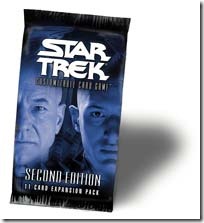
For those who are not in ‘the know’ – a CCG is a Collectable or Customisable Card Game. You buy packs of cards with a random contents, and use these to construct a deck. Your opponent will choose his own cards. In theory, this is a gaming heaven – it allows for endless variation in games, as you each have different cards to choose from, and can combine useful cards together to make powerful strategies.

Unfortunately, not all cards are created equally. Some cards, you will have a dozen copies of. Others, you may never ever see. The only ‘complete’ sets I ever managed to get were ones I bought on eBay, ready-collected.

This randomness can also cause problems in tournaments. Star Trek CCG remains the only game that I have played in a tournament – a monthly affair run by a Friendly Local Game Store that may not even exist now. It certainly hasn’t run ST:CCG tournaments in a long time. Because you need lots of money to ensure you get more different cards (and piles of duplicates stacked up beside it), you’ll be in a better position than someone who has a limited disposable income. For this reason, I would name any CCG with the standard randomisation model as an enemy of the Frugal Gamer.

On the other hand, there is a variation on the CCG that seems to bring all the benefits, but designed for a Frugal Gamer. It is the Living Card Game, as developed by Fantasy Flight Games, and works differently. When you buy an expansion for an LCG, you get all the cards in that expansion. They come in different quantities, but these are set and not random. If you buy one of every pack, you’ll have one of every card in the game. The plus-point of the basic CCG – the Customisable point – is still present, in that you tailor a deck out of the cards you have available. There’s no scrounging around for that one rare card that might or might not be in the pack you’ve just bought, you can guarantee that the box you buy has the card you want.

Personally, I’ve been experimenting with Warhammer Invasion: The Card Game from FFG.
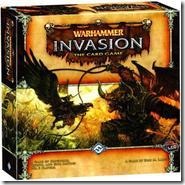
warhammerinvasion I would definitely recommend the core game, although it obviously has extra appeal to those familiar with the Warhammer world. It can be played in about an hour, but the draft format rules can easily take as much time as the rest of the game (if you’re an indecisive person, especially). These are not necessary to the game itself, only if you want to introduce a semi-random deck construction into your games. There is a balance involved in defending each of your zones, generating resources and drawing cards, and attacking your opponent. Getting that balance while being attacked yourself is a fun part of the game.

The basic setup of the game allows for lots of variation – even using the same decks over and over, I’ve found very different tactics for each side depending on which cards are drawn. Each different faction has it’s own flavour, and can be mixed along the broad ideological lines of the Warhammer world (Order vs. Destruction) to open up the options even further.

The rules are quite simple, and can be taught to new players fairly quickly. Working out how to best use their cards may take a while longer, but that’s a matter of practice with any new game. I have found that some of the rules didn’t quite fit at first, compared to games I am used to. The method of assigning damage, then taking actions, and finally applying the damage can open up a range of new, devious tactics but it also takes some getting used to. In the same vein, I have made assumptions about how some cards work and been quite wrong. The best example is that if something says ‘Destroy all units’ it means to destroy all units, for all players.

As far as memorable moments go, a few nights ago my wife was ready to destroy me with two Great Unclean Ones when I decided it was the perfect time for a ‘Destroy all units’ card – the board was effectively reset, and I just had to deal out damage before she finished me off. That one card saved me, and gave me a victory! Before that, I’d never been sure about cards that wipe out your own forces.

The quality of the components is very high – it might seem slightly pedantic to notice this, but even the damage/resource markers are sturdy, thick pieces that look like they’ll last a while. The cards themselves are printed right out to the edges, with no borders, and this looks much better than other systems with a border – in the case of my first CCG, Star Trek, sometimes the borders were of different colours for collector’s sakes!

My gripe would be, however, that the core game doesn’t offer enough in the way of effective themes beyond the main factions. There’s no real purpose to adding Chaos cards to an Orc deck, they would only interfere with each other’s themes. Dwarfs and High Elves will go together slightly better, with one healing units and the other healing your zones, but it’s a fairly weak mix (there are few Elf cards in the core game, let alone those on the theme).

The expansions add to the mix, expand the themes, and offer more options but the rub there is that although the first themed expansion set (‘The Corruption Cycle’) adds the Skaven as a sub-faction, it does so spread across all six expansions in the set. As each expansion costs between £5 and £8 (depending on where you find them), to get a full range of Skaven cards – each of which assists the others with thematic synergy – will set you back a fair bit of money. For serious tournament players, you may need to triple the cost to get the maximum number of cards, but I think of serious tournament players as being less than frugal in games of this sort. The best bet for regular gamers who want to compete at that level is to share with your friends and enter with two different decks. Quick note: Fantasy Flight Games are revising their expansion format, so they cost a little more and contain three copies of each card – which eliminates the need for multiple purchases, and works out at the same or less per card. This won’t take effect till later this year, and won’t be back-dated to the packs already released.

Overall, I think the Living Card Game format is a very welcome successor to the original CCG format and although I’ve griped about the overall cost of a linked expansion set, you still get significantly more cards for the same money as a CCG set – and with less risk in the purchase, too. In this particular case, the game is quick, fun, easy to learn and has enough variety in the core box to keep you playing for a while. Also, while it describes itself as a two-player game and has no specific rules for multiplayer variants, several cards say ‘one target opponent’ and ‘each opponent’ so I believe it wouldn’t be hard to play a multiplayer game and move the options out even further. Since you can choose your level of involvement as it comes to expansion packs, I’d call this a good game and a frugal pick!

Sunday, 28 February 2010

Dark Elf Plan

If I’m going to get anywhere with my resolution to have all my Dark Elves painted by the end of the year, I’ll have to have a plan ready before I lose too much time.

Having ransacked the shelves and boxes that house my collection, I’ve taken stock of the unfinished models. When I say ‘ancient’ below, I’m referring to the (mostly, if not exclusively) Marauder miniatures that Games Workshop sold in the mid-1990’s. I expect most of those models are also made of lead, and were carved by hand using flint tools.

Paint needs removing painttostrip

  • 1 Dark Pegasus, without rider
  • 1 Manticore with partial rider
  • 1 badly damaged Hydra that has been glued, puttied, pinned, and soldered and still won’t stay together. I really don’t know what to do with this one, except corrosively strip the various layers of adhesive and paint off, and maybe try something new (like magnets). It’d be nice to get it back together, but I have a bad feeling I’ve ruined it.

These models will need some extensive work on them. I got the Dark Pegasus and Manticore in an eBay sale, and they don’t have (complete) riders. I’m planning to put a Crone Hellebron conversion on the Manticore eventually, but I’ve not started looking at parts to complete that yet. I don’t want to rush them just to fit within the year’s resolution, so I may treat these models as 'bonuses’, if I have the time to do them.

  • 19 ancient plastic swordsmen
  • 1 ancient Corsair that needs some repairs (weapons missing!)
  • 4 ancient Corsairs

Unassembled / modelling required 

  • 2 modern Cold One Knights
  • 4 modern Black Ark Corsairs
  • 3 ancient plastic swordsmen that need a weapon swap.
  • 2 Gamezone harpies

Undercoating requiredleadpieces

  • 1 modern Hydra needs a nice base added (bits of enemies, etc) before undercoating.
  • 20 ancient Corsairs
  • 2 ancient bolt throwers and 1 modern one, all with their matching crew. I may delay the ancient bolt throwers to try and give them a bit more sex appeal, since they are rather... blocky.
  • 7 ancient Cold One Knights
  • 10 Dark Riders to undercoat (horses already undercoated).
  • 12 ancient Witch Elves
  • 6 ancient Crossbowmen
  • 12 ancient Black Guard
  • 1 ancient command group
  • 2 ancient assassins
  • An ancient male sorcerer
  • An ancient Morathi model (with clothes on!)
  • 1 Chariot crew
  • 1 modern Hydra Beastmaster team
  • 1 modern Sorceress on foot and 1 mounted on Cold One
  • 1 modern Master on foot and 1 mounted on Cold One
  • 1 modern Assassin
  • 3 modern Cold One Knights
  • 1 Malekith on Black Dragon
  • 1 Lokhir Fellheart

I do have an additional Cold One knight, left over as I got four ancient Cold Ones without riders as an eBay win and inherited a rider without a steed from a friend of a friend’s old bits box. But I’m unsure yet whether or not to make a Black Chariot with four Cold Ones pulling it, or two regular chariots, or have a Black Chariot with three creatures and use the spare to bolster the Cold One Knights. Having three chariots would be fairly nice... Although I often face cannons (boo).

Unpainted

  • 10 Dark Steeds
  • 12 modern Crossbowmen
  • 4 modern Witch Elves
  • 1 ‘middle-child’ Beastmaster team for the (damaged) Hydra
  • 6 Mengil Manhide’s Manflayers

So my first task will be to assemble the remaining Cold One Knights and Black Ark Corsairs, and perform any repairs on the existing models. Then I can devote a bit of time to painting each week before the good weather comes and I can undercoat the bulk of the models, which will give me a lot more to work on! I figure I can probably get about 2 hours a week, spread across evenings and the weekend, to chip away at this mound of metal. I’d rather hoped that there would be more models ready to paint, so if I got the time before undercoating weather came along I’d be able to get ahead on things. No matter, I like a challenge!

Thursday, 11 February 2010

A Night To Remember

As I mentioned before, I plan to hold more Games Nights this year than I have previously. Here’s what I’ve found that works for me, but I’m refining my process continually and if anyone else has any advice I’d be happy to try it out next time.

Know Your Audience - “What Do I Do Again?”

Not everyone games like a wargamer games. Wargamers are a little scary, they can assimilate any rules system almost on contact, and be playing the game without the rulebook in under ten minutes. However, not everyone has this ability. They need a little more time to pick something up, and maybe a couple of practice runs.

Knowing what sort of people have come to your games night is important, unless you want to be a speaking rulebook all evening!

Know Your Audience – “Has Someone Won Yet?”

Some games take a long time. Everyone’s been part of a 30-hour Monopoly marathon, where four players are gripping onto their last mortgaged properties in the face of the last two players, who’ve neatly divided the board between them. Being one of those destitute four is not fun. Games with clear end goals are best – ones that state that ‘the winner is the first to grab the McGuffin’ are better than ‘the last one standing’.

Cheat Sheets

If you know what games you’re playing in advance, get an A3 pad and some marker pens and make some quick bullet-point notes to remind people of key rules. Good things to put on these reminder sheets are the win conditions, the order of actions in a turn, or the options available to a player. As noted above (“What do I do again?”) if you need to use too many bits of paper, you might have picked a complicated game!

Bit of Fun

One thing we ask people to do is to bring along a token or pawn for themselves to use in the games. Wargaming friends are likely to bring a painted model, whereas normal people usually bring more interesting or unusual things (a bolt, small crystal, box of staples, etc). I recommend limiting to things that generally balance themselves and are no more than an inch square at the base. I reserve some goblins for people who neglect to bring their own.

Survival Considerations

This is less specific games advice and more basic party etiquette – you should have a selection of sweet and savoury snacks, and drinks around. We normally ask people to bring their own beer, and stock up on cheap colas ourselves. Popcorn will go a long way. Another good practice is to appoint someone as Pizza Prefect. It is their job to memorise a takeaway pizza menu, calculate available offers, sort out what each individual wants and then make the order. If you happen to be ordering a lot of pizza, you may get an additional discount.

Friday, 22 January 2010

Pete the Frugalista

Hey, Frugal Gamers! I think I had best introduce myself before the year disappears any further. My name is (don’t all shout at once) Pete, and I’ve been following Dave’s blog since I read about his fantastic tips for Dettol as a paint remover. This changed my life – primarily, it changed the way I smelled and the expression on my wife’s face on an evening, as I spent yet more time with a toothbrush and a tub of antiseptic Dark Elves.

Since you can’t stop me (moo ha ha), I’ll explain a bit of my history. I started gaming many years ago, when Games Workshop had a sale. I bought a lot of Dark Elves, and lost many games with them against a more experienced friend. Since then, I have played a range of GW games (Necromunda, Gorkamorka, Warhammer 40K, Mordheim) and lost a truly hideous number of games. I’ve also branched out into other game genres – card games, board games, roleplay games, and I’ll give anything a try if it becomes available.

As a frugal gamer, I have my own plans for fulfilling the Two Commandments of Dave:

Spend Less

I’ve already not done too well at this one, to be honest. Already this year, I’ve bid on a number of items on eBay to try and round out my collection. As far as new models go, I am resolved not to buy anything unless it is in a sale – Maelstrom Games is my store of choice for GW models, and they hold sales throughout the year with up to 17% off. This is a boon for anyone looking to save money on their models!

I feel that my losses here will be slightly mitigated by selling old games. I have a huge collection of Star Trek CCG cards which have been waiting for many years to come out of storage. I didn’t expect their eventual return to be a cataloguing exercise, prior to selling them. I also plan to go through old models and sell off anything that’s never going to get painted.

Play More

Games are no good sitting in cupboards. To this end, I am going to try and hold a Games Night at least every six weeks – that should be eight nights by the end of the year. My wife and I have held a few over the last couple of years, but we have a young son now and painful experience last year has taught us that we need to find a babysitter to make a Games Night work well. I will, however, be including any babysitting costs as a gaming cost this year, just to keep myself on focus!

Pete’s Year Ahead

One of the resolutions I have set myself is to paint all my Dark Elf figures. This resolution should help me stop buying too much more for them, because if I buy more... then I have to paint more. This doesn’t make sense (but then, when have gamers ever really made sense?) I plan to bring you any painting tips I learn along the way – nothing to save money, but at the very least it’ll make me feel guilty if I fall behind!

Alongside my Games Night resolution, I’ll use the opportunity to review games and give advice on how to run your own Games Nights.

Finally, writing this introduction has made me realise that I have quite a few things that I want to run forward with and talk more about that could easily become their own essays. I’ll be sure to write about those when I get the chance to.